|
you find yourself
‘You find yourself...’ definitely is the best opening line to any adventure story, to life. It once marked your entry to the multi-user dungeon and whatever they were called after. ‘You find yourself in a dimly lit room. There’s two doors, one to the west and one to the east. There’s a staircase leading up. Baby_Niagara and Zoltan14 are here.’ Et Cetera. Text based multi-user online game environments.
Gitarist Bill Frisell Disfarmer Project / vprojazzlive.radio6.nl
 awe at the sun
Look for Small Numbers / I Calculate Ergo Sum
For some time the idea of the multiple has ruled over the idea of the unique in the critical debate, in cultural production. Political and artistic minds were challenged by the nature, the mood and the dynamics of massive information, massive connectivity, massive mobility. ‘Mass Elitism’ was suggested but did not gain a lot of momentum beyond cosmetic customization.
The strictly political idea to drown anything in numbers first and then figure out how to swim is a clear sign of fatalism-false egalitarianism. Anyone who calls numbers has the tendency to situate himself outside the multiple. Look at those numbers! Or is a flagellant. I’m only one! Some of us do meet a situation in life where we have to manage large numbers for environments where we can not leave the écriture automatique to a machine.
The more I count, the more I calculate.
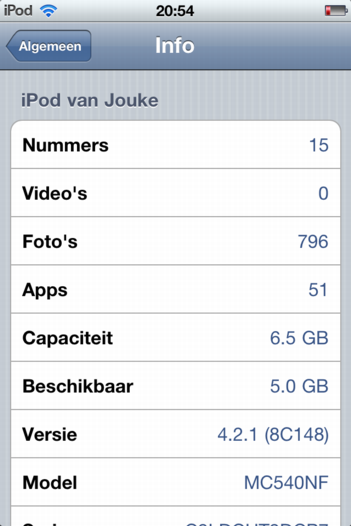 the situation, 20:54 and ever after
World Wide Appetite
Since our 24 December 2010 take-off to Jakarta I am new to the world of app-embedded publishing presence.
I was told no lies by some who went before me. It is the new Conversational Drift, coming with all new Informatic Licenses, growing all the new Exquisite Enclaves.
To me, apps on a networked pocket device mean the rediscovery of photography, the rediscovery of radio, the rediscovery of the weather, the rediscovery of the news, the rediscovery of public transport, the rediscovery of the drift, the rediscovery of recorded life, the rediscovery of hesitation between the private and the public. It’s all new, and rediscoveries. Of most importance: the rediscovery of friends and colleagues with whom the different levels of privacy and privilege count most. All said ‘phenomenons’ come back to me in their original greatness. A greatness that is so powerful that it makes the World Wide Web and the Internet at large invisible again — like it should probably be most of the time. Its visibility was an intermediary stage of their development. Media are invisible to us, notwithstanding that in their emancipatory development and in our own emancipatory development they had to be made visible by artists and academics for a couple of decades. Look at the tools, folks! Look at what is behind, or maybe even all by itself, the proper illusion of reality!
The good book is invisible. The good movie is invisible. Good theatre is in your face invisible. Good photography, invisible. Media primarily have always become visible in the hands of dilettantes who could not construct an experience without showing off not their conceptual or visionary, but their technical skill. In postmodern times however to emphasize the medium became common practice with major artists alike. They were looking for the illusion apparatus more than for the illusions. As a result the image doubled and produced an illusion of the illusion apparatuses. Art cannot escape art. It deals with illusions, sells you experiences and always remains invisible as mechanism (...).
Visibility of media, a historical period in which indeed the medium was the message, is of emancipatory importance. Notions developed in such a period forever change our media literacy. In literacy we travel from invisibility, to visibility, to invisibility, and so on for ever. This progressing pendulum is the nature of discovery and invention, the nature of knowledge and learning. As with any epistemological process the (in)visibility pendulum becomes the nature of politics, economics, belief systems of sorts.
Media misery: the encyclopaedia was more visible than the world which was unfolded (and constructed) inside of it. With the apps, the phenomenons of photography, radio, weather, news, public transport, life, publishing et al come back to me, getting around(?) the encyclopaedia, around the medium, in such a way as the original phenomenons come to me. App-embedded phenomenons appear like the phenomenons themselves, they are not an Internet address, they address you. If your friends are behind them, use them as a channel, they address you and so do you when you address them. Path is the new Flickr. Path does not share photos, it shares moments in life, it shares lives — it addresses people, not subjects.
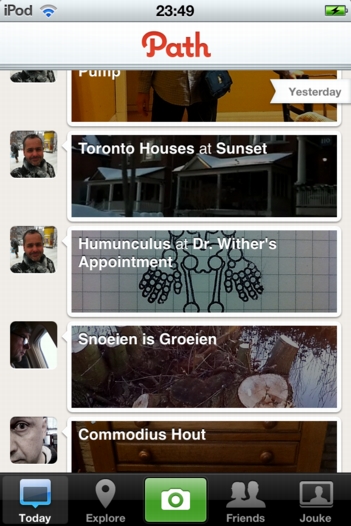 the path, 23:49 and ever after
Path is only an app of course. An app that lets you pick a couple of friends to share your photos with. A maximum of 50 friends. Already to meet a limit in anything computational or net distributed is a reality check. Your 500 Facebook friends aren't your friends. It’s at best an audience of people who think or hope to know you because, well because a large number of friends looks right on their FB page.
The next Path?
 dog at dawn, 21 January 2011 and ever after
Wamena, Papua, Indonesia

Because apparently it can be hard to get out of Wamena, flights being postponed or canceled for no apparent reason, we plan a couple of days to get back on the Jayapura-Jakarta flight. Also, we obey what seems like sound advice: confirm a return flight upon arrival, be sure to have your name pencilled down on the passenger list, on departure day be at the airport before check-in time, arm wrestle with the other passengers to get your ticket through the check-in window into the hands of someone who seems to be in charge, be the first one to drop your backpack on the scales.
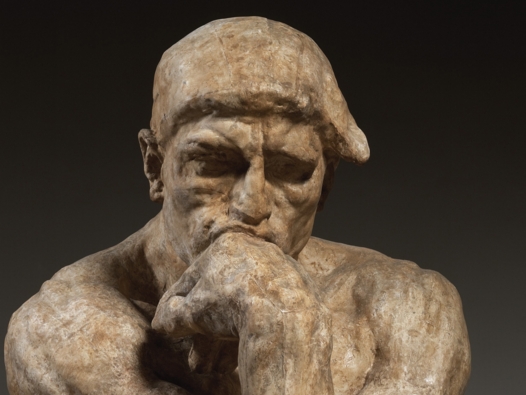 Rodin penseur model
The more I think, the more I think
‘Plus je pense, plus je pense’ wrote Paul Valéry in 1898 as the first line of a never finished poem, Agathe, Sainte du Sommeil.
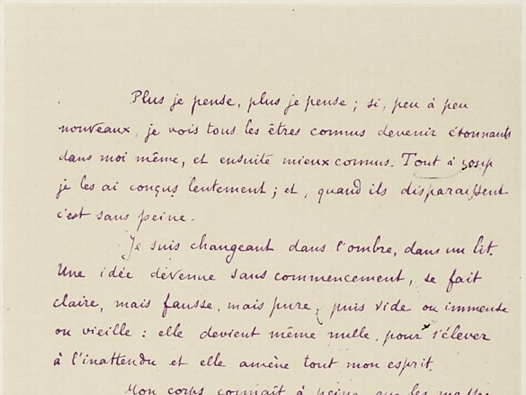 Paul Valéry’s handwriting facsimile in a 1956 posthumous publication of
Agathe, Sainte du Sommeil, Tallone, Paris, 1956
In Jakarta at Periplus bookstore (publishers of the priceless Periplus Adventure Guides, that’s what channeled us there) I buy edge.org Jonathan Brockman’s (ed.) ‘Is the Internet Changing the Way You Think?’, to read on the flight home. Reproduced from their site, where the 2010 question appears to be phrased “How is the Internet Changing the Way You Think?”, okay, some random checks prove the answers remain the same online as in print. The list of contributors rings a 1990s early adopters familiar bell: Esther Dyson, Jaron Lanier, Kelvin Kelly, Eric Drexler, Danny Hillis, Howard Rheingold, Douglas Rushkoff, Stewart Brand, Roger Schank, David Gelernter, Mihaly C., Tim O’Reilly... What is thought of thinking ‘by the net’, after almost two decades of the medium’s explosive popularization?
The more I surf, the more I surf? Well, to surf and to think have at least one common effect.
Most of the answers that I read speak of changes in what is thought (about), or obviously, how thoughts are now tested against or built up on the thoughts of others. The Internet delivers endless data and connects us to those who, like ourselves, construct and contextualize information. Many contributions in one way or another regret the older thought accompanying and provoking and connecting data centres like libraries. But sure, that’s not all there is. Since I slept during that long flight (and wandered off a couple of hours in Hong Kong) the book is now reopened on my Amsterdam table. Delving into it a little more I will keep posting bits to NQP, for its ‘Quotes’ department.
The Internet also alters our perception of duration. Sometimes, when working on an obstinately analog process such as the actual fabrication of an object, the internalized shadow of fleeting Internet time in our consciousness makes us perceive how the inevitable delays inherent in the fashioning of things (in all their messy ‘thingness’) ground us into appreciating the rhythms of the real world. In this way, the Internet’s pervasive co-presence with real world processes, ends up reminding us of the fact that our experience of duration is now a layered thing. We now have more than one clock, running in more than one direction, at more than one speeds.
(Raqs Media Collective, New Delhi: Artists, Media Practitioners, Curators, Editors and Catalysts of Cultural Processes)
One Click Distraction.
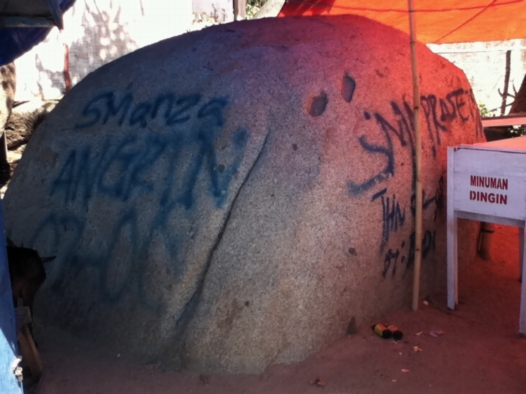 rock in sea side bar, 4 january 2011 and ever after
Gorontalo, Sulawesi, Indonesia
Outside Gorontalo’s east side harbour a shady rock sits in the middle of a small bar. Minuman dingin — cold drinks — would be served, probably just over the weekends. The bar is closed. Up in the village I am invited to play a set of table tennis. The table is made of planks but otherwise in even condition. The small crowd gathering is easily entertained. As with any new adversary we have a problem with each others serve. We don’t keep the score.
 sun rise crowd, 4 february 2010 and ever after
Three seas, three winds, three suns await us.
|
|